
There is a very specific kind of heartbreak that comes from realizing you are, once again, completely obsessed with something new.
Not casually interested. Not “this might be fun to try.” I’m talking about the kind of interest that quietly takes over your personality for a few weeks. The kind where you start mentally rearranging your entire life to make room for it. The kind where you think, this could actually be it.
You buy the notebook.
You open the tabs.
You reorganize your schedule in a way that feels wildly optimistic and completely justified.
You tell a friend, or three, “I think this might be my thing.”
And for a while, it is.
You feel focused in a way that makes you wonder why you’ve ever struggled before.
You’re consistent.
You’re motivated.
You’re already imagining what this looks like six months from now, a year from now, when you’ve finally stuck with something long enough to become the kind of person who is known for one thing.
And then, without much warning, the feeling changes.
It’s subtle at first.
A little less exciting.
A little harder to start.
You notice a few flaws.
You feel a flicker of resistance where there used to be momentum.
And then one day you realize you haven’t thought about it at all. The tabs are still open, but they feel… stale.
And right on cue, the thought shows up.
Why can’t I just stick to one thing?
👉🏻 The Dark Side of Being a Multipassionate
The Lie That Keeps You Stuck
If you’ve ever typed some version of that question into Google, you already know what comes next. The advice is predictable, almost rehearsed.
You need more discipline.
You need to focus.
You need to stop jumping around and pick a lane.
It’s not bad advice. It’s just not the right advice for YOU.
Because it assumes that the goal is to become someone who thrives on repetition, consistency, and a singular path. It assumes that success looks like narrowing down, committing early, and staying the course no matter what.
And if you’re reading this, there’s a good chance that has never quite felt right, no matter how hard you’ve tried to make it fit.
There’s a reason for that.
Your brain doesn’t operate in straight lines. It operates in patterns of curiosity. It follows threads, pulls ideas apart, connects things that don’t obviously go together, and then, once it feels like it has learned what it came to learn, it moves on.
That’s not a flaw. That’s a design.
If you haven’t already fallen down the rabbit hole of this concept, this is where everything starts to click: What Is a Scanner Personality? (And Why You Were Never Meant to Do Just One Thing). Because the moment you understand that there are people whose brains are wired for depth through variety, not depth through repetition, a lot of your past starts to make a little more sense.
The Pattern That Feels Like a Personal Failure
The reason this feels so frustrating isn’t just that you lose interest. It’s that you care.
You don’t start things halfway.
You go all in.
You invest time, energy, sometimes money.
You let yourself imagine a future where this thing works, where you finally prove to yourself that you can follow through.
So when your interest fades, it doesn’t feel neutral. It feels like you did something wrong. It feels like another piece of evidence in a growing pile that says you lack discipline, or consistency, or whatever trait you’ve decided is the missing ingredient between you and everyone else who seems to have it figured out.
But if you zoom out, the pattern is actually incredibly consistent.
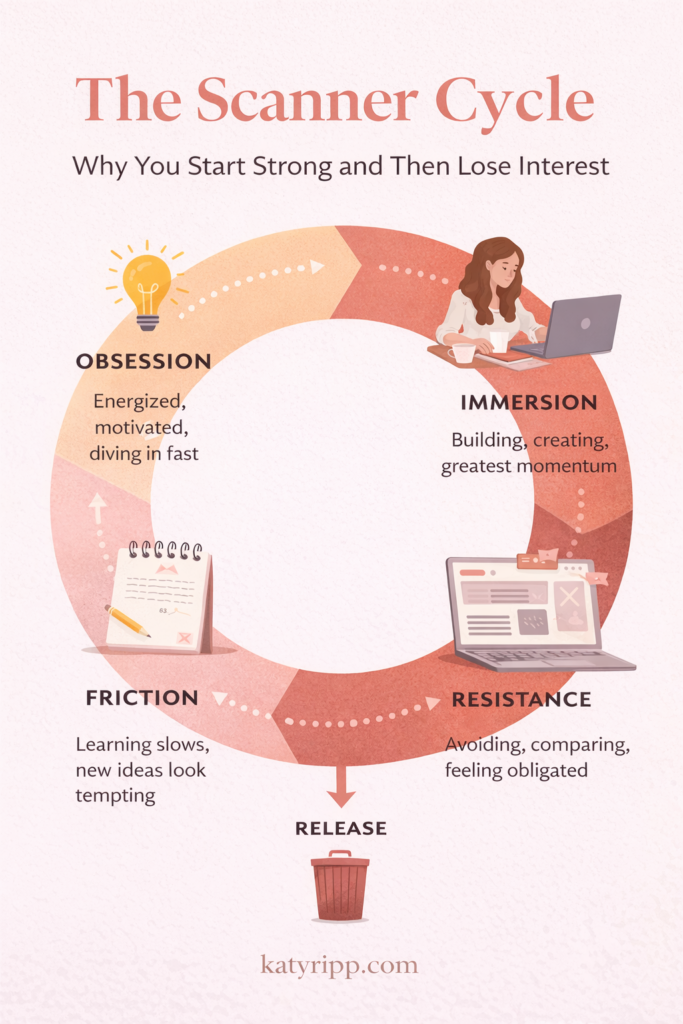
You start with curiosity. That curiosity turns into momentum. Momentum turns into immersion. And immersion eventually turns into resistance, not because you’ve failed, but because your brain has reached the point where the learning curve flattens out. The novelty fades. The questions become fewer. The edges soften.
And for a brain that is fueled by curiosity, that moment doesn’t feel satisfying. It feels like friction.
This is the part no one really talks about in the “just push through” advice. Because sometimes pushing through isn’t building discipline. Sometimes it’s ignoring the way your brain is actually trying to guide you.
Boredom Isn’t a Character Flaw
We’ve been taught to treat boredom like a problem to fix, something to override or outwork. But for you, boredom is often information.
It’s the signal that you’ve extracted what you needed from that particular thing. It’s the moment where your brain is quietly asking, is there something else here worth exploring, or is it time to redirect?
That doesn’t mean you abandon everything the second it gets hard. It means you learn to distinguish between discomfort that leads to growth and discomfort that comes from forcing yourself into a shape that doesn’t fit.
There’s a difference between challenge and misalignment. One expands you. The other drains you.
And when you’ve spent years trying to act like someone who thrives on doing the same thing over and over again, it’s easy to confuse the two.
You’re Not Lazy. You’re Misunderstood (Mostly by You)
One of the hardest parts of this whole experience is how quickly it turns inward.
It’s not just that you move on from things. It’s the story you tell yourself about it. The quiet narrative that you’re scattered, or unreliable, or that you just need to get your act together.
Meanwhile, you’re probably the person people come to when they need ideas. When they’re stuck. When they want to see something from a different angle. You can connect dots, pivot quickly, learn fast, and bring energy to new things in a way that a lot of people can’t.
But because you’ve been measuring yourself against a standard that was never designed for you, those strengths don’t always feel like strengths. They feel like evidence that you can’t stay still long enough to succeed.
If this is hitting a little too close to home, you might want to read Why Do I Have So Many Interests? The Truth About a Multipassionate Mind next, because this isn’t random. It’s a pattern with a name.
What Changes When You Stop Forcing It
The shift doesn’t happen when you suddenly become a person who sticks to one thing forever.
It happens when you stop trying to.
When you start working with the way your brain naturally moves instead of constantly trying to override it, something really interesting happens. You begin to see your past differently. Those “unfinished” projects start to look more like completed cycles. Those pivots start to look like data, not detours.
You also get more intentional.
Instead of chasing every new idea with the same level of urgency, you start to create containers for them. You give your curiosity somewhere to go that doesn’t require you to immediately restructure your entire life around it.
And instead of asking, why can’t I stick to one thing, you start asking better questions.
What did I learn here?
What do I want to carry forward?
What actually deserves my energy right now?
That’s a very different conversation.
If You’re Starting to See Yourself in This
There’s a good chance this isn’t the first time you’ve wondered if your brain just works differently. It might be the first time it’s felt like that could actually be a good thing.
If you’re nodding along to all of this, the next step IS NOT to fix yourself. It’s to understand yourself a little more clearly.
👉 Take the Scanner Quiz and see where you land. It’ll help you start to put language around how your brain works, which is where everything else begins.
And if nothing else, let this be the thing you take with you:
You don’t have a follow-through problem.
You have a wiring that was never meant to follow a straight line.
And once you stop trying to force it to, things get a whole lot easier.
Scanner Personality FAQ
Is a scanner personality a real psychological term?
The term scanner personality was popularized by author Barbara Sher to describe people who are naturally curious and interested in many different subjects. While it is not a clinical diagnosis, many people strongly identify with the description of having a multipassionate mind that thrives on exploration and learning.
Do scanner personalities struggle with focus?
Scanner personalities usually don’t struggle with focus itself. In fact, they can focus intensely when something is interesting or new. The challenge often appears once an idea becomes repetitive or predictable, which can make scanners feel ready to move on to the next curiosity.
Are scanner personalities successful?
Many scanners build successful lives and careers by combining multiple interests rather than choosing only one path. Entrepreneurs, creatives, writers, and innovators often have scanner tendencies because they enjoy exploring ideas across different fields.
Is a scanner personality the same as ADHD?
Scanner personalities and ADHD can sometimes overlap, but they are not the same thing. ADHD is a neurological condition related to attention regulation, while a scanner personality simply describes a pattern of curiosity and having many interests. Read the full article about ADHD vs. Scanner Personalities
How do scanners manage so many ideas?
Many scanners benefit from creating systems to capture ideas so they don’t feel overwhelming. Having a place to store inspiration allows scanners to revisit ideas later instead of feeling pressure to act on every idea immediately. Download the FREE Scanner Idea Parking Lot too.
What other articles should I read about scanner personalities?
If you’re curious about scanner personalities and multipassionate minds, these articles explore the topic from different angles:
• What Is a Scanner Personality? – a simple explanation of what scanners are and how this type of curiosity works.
• 15 Signs You Might Be a Scanner Personality – a list of common traits that many scanners recognize in themselves.
• Why Having Too Many Interests Is Actually a Superpower – why curiosity and exploring many ideas can become an advantage rather than a problem.
• ADHD vs. Scanner Personalities: What’s the Difference? – an important distinction that many people wonder about when learning about scanners.
• How to Organize Your Ideas When You’re a Scanner – practical strategies for managing lots of interests without feeling overwhelmed.