
The highest-ROI things to work on when you’re a small business owner with approximately 47 things demanding your attention.
There is a particular problem that comes with owning a small business: you can work all day, every day, and still never work on the things that would actually make the business better.
There is always something.
An email to answer. An employee question. A customer who needs something. An Instagram post you forgot to make. A bill to pay. A website button that’s broken. A refrigerator making a noise that absolutely does not sound like a $200 noise.
Ask me how I know.
I’ve owned businesses with employees, buildings, inventory and customers walking through the door. I’ve built online businesses, coached business owners, created offers, sent newsletters, started podcasts, built websites and changed my mind approximately 700 times.
And one of the hardest things I’ve learned is this:
Working hard and working on the right things are not the same thing.
Some work keeps the business running today.
Other work makes the business easier, stronger or more profitable six months from now.
That’s the work I’m talking about here.
When I say high-ROI priorities, I don’t necessarily mean whatever makes the most money immediately. I mean work that gives something back: more money, more time, more clarity, more capacity or fewer problems later.
If you have a few hours to work on your business this week instead of just in it, these are the six places I’d look first.
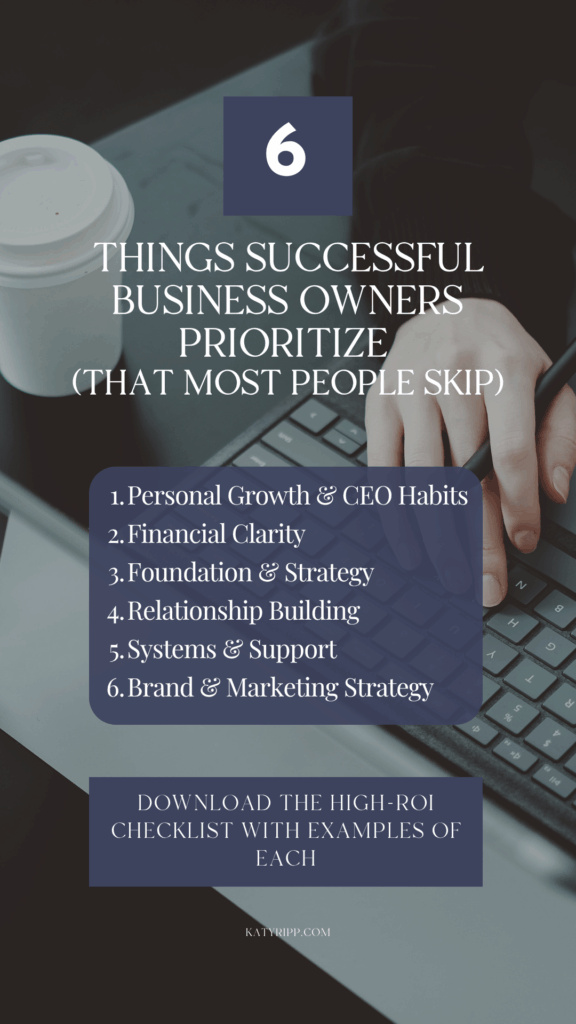
1. Personal Growth & CEO Habits.
It took me a long time to realize that thinking is part of my job.
When you’re used to measuring productivity by how many things you crossed off a list, sitting somewhere with a notebook and asking yourself what is actually working can feel suspiciously like doing nothing.
It’s not.
If you’re always answering emails, putting out fires and checking off tasks, you’re managing the business you already have. You need some space to think about the business you’re trying to build.
You don’t need an elaborate CEO retreat or a leather notebook embossed with the word VISIONARY. Thirty uninterrupted minutes can do a lot.
High-ROI things to do:
- Look at what’s working and what isn’t.
- Decide your three most important priorities for the next 90 days.
- Ask what you’re doing simply because you’ve always done it.
- Notice what’s taking a disproportionate amount of your time or energy.
- Make one decision you’ve been avoiding.
This is also where my Four Currencies framework has become incredibly useful. Money isn’t the only thing a business costs. Every decision also spends your time, energy and attention. A profitable opportunity can still be a terrible trade if it’s draining the other three.
2. Financial Clarity
Avoiding your numbers does not make them less real. I have conducted this experiment personally. 😂
Financial clarity doesn’t mean becoming a spreadsheet person or knowing what every line on your P&L means without Googling it.
It means knowing enough about your business to make decisions from information instead of anxiety.
At minimum, you should have some idea of what’s coming in, what’s going out and which parts of your business are actually making money.
High-ROI things to do:
- Review your profit and loss statement.
- Know your biggest monthly expenses.
- Look at your cash flow for the next 30–90 days.
- Review your pricing.
- Know which products, offers or services are most profitable.
- Cancel expenses you’re no longer using.
- Decide what the business can realistically pay you.
Revenue can make a business look healthy while the actual numbers tell a completely different story.
You don’t need perfect books to start paying attention. You just need to stop making money decisions in the dark.
3. Foundation & Strategy
This is the unsexy work that makes everything else easier.
What are you actually selling?
Who is it for?
What problem are you solving?
What do you want this business to become?
And maybe most importantly: what don’t you want it to become?
I’ve spent plenty of time building things simply because I could. That’s an especially easy trap if you’re a multi-passionate person who can see seventeen possible directions at once.
Being capable of doing something doesn’t automatically make it a good business strategy.
High-ROI things to do:
- Clarify your core offer or revenue streams.
- Identify the customer you most want to serve.
- Decide what you’re actively trying to grow.
- Decide what you’re willing to stop doing.
- Review whether your current business still supports the life you’re trying to build.
A good strategy doesn’t tell you every move you’re going to make for the next five years.
It helps you say no to the moves that aren’t taking you where you want to go.
4. Relationship Building
I will take a real relationship over an algorithm hack approximately 100 percent of the time.
Some of the best opportunities in my businesses have come from people I already knew: former clients, customers, friends, collaborators, community members and people who knew someone who knew someone.
And relationship building doesn’t have to mean “networking,” especially if the word networking makes you want to fake your own death.
It can simply mean staying connected to actual humans.
High-ROI things to do:
- Check in with a past client or customer.
- Ask a happy customer for a testimonial.
- Follow up with someone you’ve been meaning to contact.
- Schedule coffee with a collaborator.
- Thank someone who referred business to you.
- Introduce two people who should know each other.
- Spend time in the community where your customers actually are.
Not every relationship needs to have an immediate ROI.
That’s sort of the point.
Build the relationship first. You never know what grows from it later.
5. Systems & Support
If you have personally performed the same annoying task 47 times, we should probably talk about a system.
Systems aren’t just for giant companies with operations departments. They’re how a small business stops requiring you to remember every single thing.
Start with the things you repeat.
How do you onboard a customer? How do you respond to inquiries? How do you open the shop? How do you publish a blog post? How do invoices get sent? What happens when someone joins your email list?
Then ask:
Does this need to be done by me?
Sometimes the answer is yes.
Frequently, it is absolutely not.
High-ROI things to do:
- Document one process you repeat regularly.
- Create templates for emails you send over and over.
- Automate a repetitive administrative task.
- Delegate something that doesn’t require your particular brain.
- Clean up one system that regularly creates mistakes or confusion.
- Write down information currently living only in your head.
The goal isn’t to automate the humanity out of your business.
It’s to stop wasting your very human brain remembering things a checklist could remember for you.
6. Brand & Marketing Strategy
Marketing gets overwhelming very quickly because there is always another place you could be showing up.
Instagram. Pinterest. TikTok. Email. Blogging. Podcasting. SEO. Networking. Video. Whatever new platform appeared while I was writing this sentence.
You do not need all of them.
You need a way for people to find you, a reason for them to trust you, and a way for them to stay connected to you.
That’s it.
For me, I’ve become increasingly interested in creating things that keep working after I make them. A useful blog post can be found through Google or Pinterest months or years later. An email list gives me a way to stay connected without hoping an algorithm decides to show someone my post.
That’s a much higher return to me than constantly feeding a platform that forgets my content existed 48 hours later.
High-ROI things to do:
- Make sure your website clearly says what you do and who it’s for.
- Create or improve an email opt-in.
- Review your highest-performing content and make more around those topics.
- Update an older piece of useful content instead of always creating something new.
- Add internal links between related articles on your website.
- Repurpose one strong idea instead of creating five mediocre new ones.
- Choose one or two marketing channels to do consistently rather than six sporadically.
Your marketing should create an ecosystem, not another full-time job.
What Should You Work on First?
This is usually where a perfectly good list turns into another giant to-do list, which would defeat the entire purpose.
So don’t do all of this.
Pick one.
Ask yourself:
What could I work on for the next hour that would make something easier, clearer or more profitable later?
Maybe it’s looking at your numbers.
Maybe it’s finally documenting something your team asks you about every week.
Maybe it’s emailing five former clients.
Maybe it’s fixing the homepage you’ve been apologizing for since 2023.
Maybe it’s deciding that an entire part of your business isn’t worth what it’s costing you anymore.
That counts too.
One of the biggest lessons I’ve learned from owning businesses is that there will always be more you could do.
Another hour. Another strategy. Another platform. Another offer. Another attempt.
The goal isn’t to exhaust every possible option.
The goal is to get better at deciding what deserves your resources.
Your money, yes.
But also your time.
Your energy.
Your attention.
Because those are currencies too.
And the businesses that feel good to own aren’t necessarily the ones where we work the hardest.
They’re the ones where we’re increasingly intentional about what we’re working so hard for.
At the end of the day, a non-burnout business isn’t built by working more—it’s built by working smarter. By prioritizing your growth as a leader, demystifying your finances, solidifying your strategy, nurturing relationships, leveraging systems, and sharpening your marketing, you’re creating a bullet-proof foundation. So grab your high-ROI priorities checklist, pick one pillar to focus on this week, and watch your business transform from exhausting to exhilarating.